
Showing posts with label Newcastle. Show all posts
Showing posts with label Newcastle. Show all posts
Saturday, August 16, 2008


Sunday, January 22, 2006
The Beatles and Newcastle United
.
Younger daughter, like her siblings, has a very catholic taste in music, ranging from hip-hop to jazz through rock to Sinatra so it should have come as no surprise when she recently began raving about some old Beatles tunes from their "No.1s" CD. She however was very surprised indeed to learn that a family friend she had visited in Sweden several years ago was a close relative of one Albert Stubbins.
.
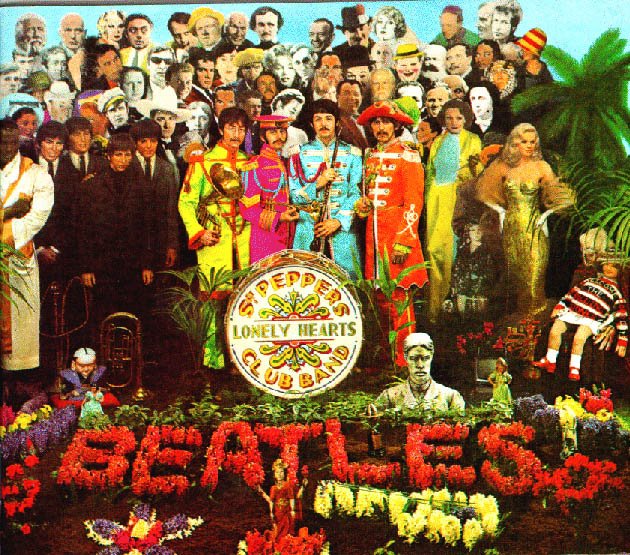
Those of you who are familiar with the cover of Sergeant Peppers Lonely Hearts Club Band may know that Albert Stubbins appears on the cover wearing a red shirt and standing next to Marlene Dietrich's shoulder
.

Younger daughter, like her siblings, has a very catholic taste in music, ranging from hip-hop to jazz through rock to Sinatra so it should have come as no surprise when she recently began raving about some old Beatles tunes from their "No.1s" CD. She however was very surprised indeed to learn that a family friend she had visited in Sweden several years ago was a close relative of one Albert Stubbins.
.
Those of you who are familiar with the cover of Sergeant Peppers Lonely Hearts Club Band may know that Albert Stubbins appears on the cover wearing a red shirt and standing next to Marlene Dietrich's shoulder
.
.
The red shirt is that of Liverpool FC a club for which Albert scored 83 goals in 180 appearances after joining the club in 1946. His goals included 24 goals in 36 games when Liverpool won the First Division title in the 1946-47 season. Despite his success at Liverpool many believe that Albert's peak years coincided with World War Two when the regular leagues were cancelled. During the 1945-46 season before regular League football was restarted, Albert scored 39 goals in the Northern League for Newcastle when, by comparison, the second-highest Newcastle scorer was Jackie Milburn with just 14 goals, yet it was Milburn who went on to become a legend on Tyneside scoring 200 goals for the club, a record only recently equalled by Alan Shearer.
.

.
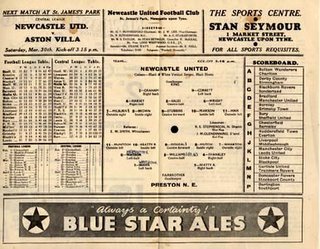
programme for Aston Villa v NUFC 1945/46 Albert Stubbins at Centre Forward. No.9
.
Freddy Shepherd, the current chairman of Newcastle United, once suggested that Alan Shearer was the greatest player in the 110-year history of the Tyneside club. When Sir Bobby Robson, former Newcastle and England manager, was asked whether he agreed he replied: "Well, there was Albert Stubbins, you know." (Stubbins scored 245 goals in 199 games for Newcastle)
.
.
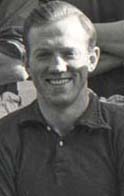
Albert Stubbins. 13 July 1920 - 28 December 2002
.
Monday, January 16, 2006
Salmon, Trafalgar and Great Grandfather George
Now what links the three you may well ask, and the answer would be the coaly waters of the river Tyne.
According to the Matriarch of the family the waters of the Tyne are now so clean that it is the finest river for rod caught salmon in the UK. So much so that the Western Mail recently reported that the Tyne had the highest catch of any British river, 4,122 in 2004. Now this should come as no surprise to those of us who, at a friend's 50th birthday a few years ago, spied a seal near the new Millennium pedestrian bridge which links Newcastle to Gateshead, no doubt drawn by the mouthwatering prospect of some fresh Tyne salmon.
And Trafalgar and Great Grandfather George?
Well, one Cuthbert Collingwood was born on the banks of the River Tyne in Newcastle in 1748 and went to sea at the age of twelve; by the time of the battle of Trafalgar in 1805 he was not only vice-admiral of the British fleet but it was his ship, the Royal Sovereign, which was the first to engage the French & Spanish fleet and it was Collingwood who took command of the fleet and led it to victory whilst Nelson lay mortally wounded .
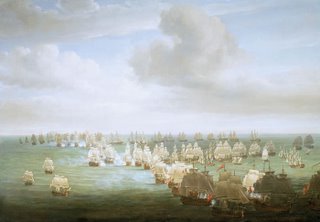
The Battle of Trafalgar, 21 October 1805: Beginning of the Action' Artist Nicholas Pocock circa 1808
As for great grandfather George, he was a keelman on the Tyne, and from an old Tyneside poem of 1820:
"Our keelmen brave, with laden keels,
Go sailing down in line,
And with them load the fleet at Shields,
that sails from coaly Tyne.
When Bonaparte the world did sway,
Dutch, Spanish did combine;
By sea and land proud bent their way,
The sons of coaly Tyne.
The sons of Tyne, in seas of blood;
Trafalgar's fight did join,
When led by dauntless Collingwood,
The hero of the Tyne.
According to the Matriarch of the family the waters of the Tyne are now so clean that it is the finest river for rod caught salmon in the UK. So much so that the Western Mail recently reported that the Tyne had the highest catch of any British river, 4,122 in 2004. Now this should come as no surprise to those of us who, at a friend's 50th birthday a few years ago, spied a seal near the new Millennium pedestrian bridge which links Newcastle to Gateshead, no doubt drawn by the mouthwatering prospect of some fresh Tyne salmon.
And Trafalgar and Great Grandfather George?
Well, one Cuthbert Collingwood was born on the banks of the River Tyne in Newcastle in 1748 and went to sea at the age of twelve; by the time of the battle of Trafalgar in 1805 he was not only vice-admiral of the British fleet but it was his ship, the Royal Sovereign, which was the first to engage the French & Spanish fleet and it was Collingwood who took command of the fleet and led it to victory whilst Nelson lay mortally wounded .
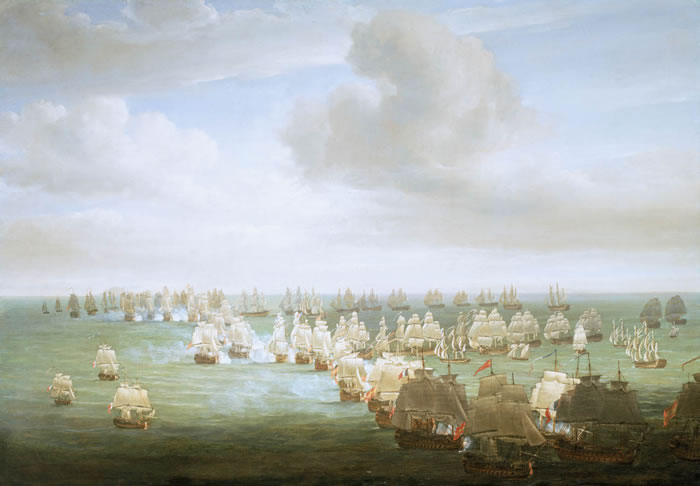
The Battle of Trafalgar, 21 October 1805: Beginning of the Action' Artist Nicholas Pocock circa 1808
As for great grandfather George, he was a keelman on the Tyne, and from an old Tyneside poem of 1820:
"Our keelmen brave, with laden keels,
Go sailing down in line,
And with them load the fleet at Shields,
that sails from coaly Tyne.
When Bonaparte the world did sway,
Dutch, Spanish did combine;
By sea and land proud bent their way,
The sons of coaly Tyne.
The sons of Tyne, in seas of blood;
Trafalgar's fight did join,
When led by dauntless Collingwood,
The hero of the Tyne.
Tuesday, January 10, 2006
Geordies and Mackems
Growing up, as I did, in the Newcastle upon Tyne of the 50s and 60s, you always knew you were a 'Geordie' and that people from nearby Sunderland on the river Wear were, well sort of Geordies but not quite. There wasn't a special name for Wear-siders. Latterly the term 'Mackem' has described people from Sunderland and supporters of their football club but only really since the 90s, so a fairly modern development.
Last night's "Balderdash and Piffle" on the BBC sought to track down the earliest recorded written evidence of the word Mackem, and courtesy of the BBC and the Oxford English Dictionary: http://www.oed.com/bbcwords/ I reproduce below some extracts from the etymology & definitions of Geordie & Mackem. As for the innate superiority it is claimed Newcastle folk have over their brethren in Sunderland I shall leave it to readers to make up their own mind:
from the OED:
1. (yellow) Geordie: a guinea. (Cf. GEORGE 4b.)
1786
2. a. A coal-pitman. b. A collier-boat. c. (See quot. 1881.)
1876 C. M. DAVIES Unorth. Lond. 353 A "Geordie", or pitman. 1881 RAYMOND Mining Gloss., Geordie, the miners' term for [George] Stephenson's safety-lamp. 1884 W. C. RUSSELL Jack's Courtship xliv, You thought..of the Channel aswarm with just such vessels as she Geordies deep with coal.
3. a. A native or inhabitant of Tyneside.
1866 C. NORDHOFF Young Man-of-War's Man iv. 69 The sailors belonging to the ports on the north-eastern coast of England are called Jordies.
1892 R. O. HESLOP Northumberland Words I. 196 The men who went from the lower Tyneside to work at the pits in South Tynedale were always called Geordies by the people there.
Mackem, n.
DRAFT REVISION Jan. 2006
Prob. with allusion to phrase mack' em and tack 'em and variations thereof, said to refer to the shipbuilding industry of the region, the suggestion being that in Sunderland they make ships (mack 'em) so that others can take them (tack 'em), or, specifically, that the Geordies of Tyneside would then take them to fit them out.
A native or inhabitant of Sunderland or Wearside; a supporter of Sunderland Association Football Club. .
The good citizens of Newcastle are aware and proud of their h-fulness: they believe that this is another instance of their inherent superiority to the 'Mackems' (citizens of Sunderland).
The earliest written record found : 1988 Sunderland Echo 17 Oct. 6/4 Five children and seven grandchildren, all Mack-ems
Last night's "Balderdash and Piffle" on the BBC sought to track down the earliest recorded written evidence of the word Mackem, and courtesy of the BBC and the Oxford English Dictionary: http://www.oed.com/bbcwords/ I reproduce below some extracts from the etymology & definitions of Geordie & Mackem. As for the innate superiority it is claimed Newcastle folk have over their brethren in Sunderland I shall leave it to readers to make up their own mind:
from the OED:
1. (yellow) Geordie: a guinea. (Cf. GEORGE 4b.)
1786
2. a. A coal-pitman. b. A collier-boat. c. (See quot. 1881.)
1876 C. M. DAVIES Unorth. Lond. 353 A "Geordie", or pitman. 1881 RAYMOND Mining Gloss., Geordie, the miners' term for [George] Stephenson's safety-lamp. 1884 W. C. RUSSELL Jack's Courtship xliv, You thought..of the Channel aswarm with just such vessels as she Geordies deep with coal.
3. a. A native or inhabitant of Tyneside.
1866 C. NORDHOFF Young Man-of-War's Man iv. 69 The sailors belonging to the ports on the north-eastern coast of England are called Jordies.
1892 R. O. HESLOP Northumberland Words I. 196 The men who went from the lower Tyneside to work at the pits in South Tynedale were always called Geordies by the people there.
Mackem, n.
DRAFT REVISION Jan. 2006
Prob. with allusion to phrase mack' em and tack 'em and variations thereof, said to refer to the shipbuilding industry of the region, the suggestion being that in Sunderland they make ships (mack 'em) so that others can take them (tack 'em), or, specifically, that the Geordies of Tyneside would then take them to fit them out.
A native or inhabitant of Sunderland or Wearside; a supporter of Sunderland Association Football Club. .
The good citizens of Newcastle are aware and proud of their h-fulness: they believe that this is another instance of their inherent superiority to the 'Mackems' (citizens of Sunderland).
The earliest written record found : 1988 Sunderland Echo 17 Oct. 6/4 Five children and seven grandchildren, all Mack-ems
Subscribe to:
Posts (Atom)