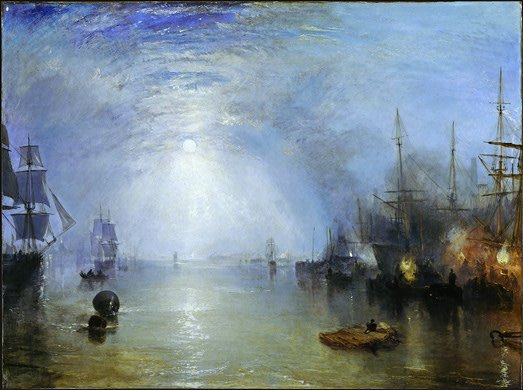
'Keelmen Heaving in Coals by Moonlight', by William Turner 1835, depicts keelmen on the River Tyne transferring coal from barges, or keels ( a word believed to be derived from a type of Anglo-saxon boat known as ceols ) to sea going vessels.
The Tyne keelmen were first recorded in 1516 and had a proud and militant history; they had their own community in the Sandgate district just outside the old city walls of Newcastle and their jobs were handed down from father to son.
In modern times the Tyne has been navigable for about 10 miles up to Newcastle but in earlier years, big ships couldn't get up the river as it was too shallow, so the Keelman's job was to ferry coal from mines up the river to the harbour mouth at North Shields, from where collier sailing ships would take their cargo down the East coast to London.
The Tyne keel was a type of barge typically holding about twenty tons of coal and was rowed in all weathers, day and night. The keelmen men would row down the river on the ebb tide, assisted by a sail if the wind was favourable, and after off-loading the coal would row back to Newcastle on the flood tide.
Coal was the lifeblood of Tyneside for centuries and Keelmen were first recorded as a fraternity in 1539. In 1697 they organised a charitable fund and established the Keelmen's Hospital in 1701 and the building survives to this day:

Keelmens Hospital. Newcastle upon Tyne
When the Swing Bridge replaced the old, low arched, Tyne bridge in 1876 it meant that larger vessels could then sail up stream to load coal from mines up the river and this was one of the final blows to the keelmen's trade
.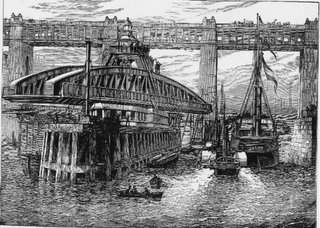
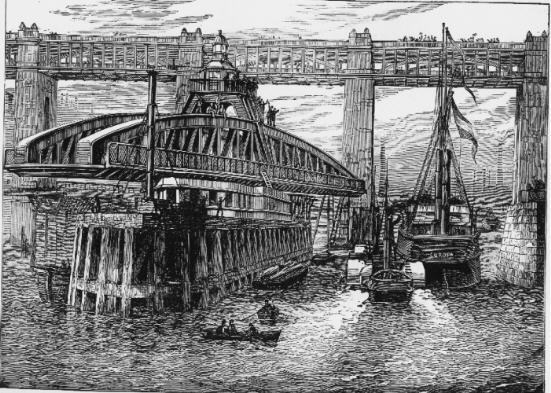
The Swing Bridge from the London Illustrated News.1876.
As steam power took over, keelmen began to carry less coal and more general merchandise. Keelmen helped found the Tyne Watermen's Association in 1870 and there were still 480 union members working on the river by 1892 but by 1910 the union was reduced to 310 members but remained independent until amalgamation with the then Northern District of the National Union of General and Municipal Workers in 1936. Ironically, coal is nowadays imported to the Tyne
All that remains of the vibrant keelmen community of Sandgate is a collection of folk songs of which the `The Keel Row' is the most famous:
"As aa came through Sandgate,
Through Sandgate, through Sandgate,
As aa came through Sandgate
Aa heard a lassie sing:
Weel may the keel row,
The keel row, the keel row
Weel may the keel row
That ma laddie's in."
Through Sandgate, through Sandgate,
As aa came through Sandgate
Aa heard a lassie sing:
Weel may the keel row,
The keel row, the keel row
Weel may the keel row
That ma laddie's in."
The 1881 census lists Great Grandfather George as a Keelman at a time when technological and other changes had pretty much destroyed the traditional role of the keelmen. The Matriarch of the family says George was to become an Inspector in the City Lighting department in the days of gas lighting. Town gas in those days was produced from coal so in a way he had transferred from one end of the supply chain to the other, and it was the Newcastle upon Tyne City Lighting Department that brought the Gordon and Bell branches of the family together, so William Armstrong, who designed the Swing Bridge, has a lot to answer for.

