Tuesday, March 28, 2006

"The Meek shall inherit the Earth." Matthew 5:5

Whilst hundreds of millions of our fellow men, women and children around the world survive on very little, many with no clean water to drink and little or no food to eat, we in the wealthier nations tend to consume to the limit that our salaries and credit cards allow.

Our homes are full of the latest gadgets, our wardrobes overflow with clothes rarely worn and we replace perfectly serviceable TVs, Hi-Fis and other appliances with newer models and then discard the old ones to pollute land and water.

All the things we collectively purchase require the consumption of raw materials in ever increasing quantities; the energy to produce and deliver them to us comes overwhelmingly from non-renewable sources and our economic way of life and standards of living depend upon a cycle of constant growth, increased demand, more production, more energy, more waste.

Is this way of life sustainable? In the short-term perhaps, in the long-term almost certainly not.

If western patterns of consumption are matched by the fast growing Indian and Chinese economies there simply wouldn't be enough oil and other raw materials to go around. Daily demand for oil from China alone would outstrip current worldwide daily production within the foreseeable future. All modern and developing economies are based on, and driven by, oil and natural gas; but these finite resources will , despite all the oil sands in Canada, run out one day.

And if a huge body of scientific opinion is correct our seemingly insatiable demand for more and more and our selfish disrespect for the natural world around us is causing global warming to increase at an unprecedented rate.

A handful of British MPs have recently called for radical measures to be taken; in effect for people to be forced to consume less to help to save the planet. The logic being, consume less, produce less, burn less fossil fuel, reduce greenhouse gases, and slow down or reverse global warming and hopefully save the planet for future generations to enjoy.

A concept doomed to failure however. Consuming less would mean less production, fewer jobs, less income, lower standards of living, less tax and fewer public services such as health provision leading to a downward spiral of relative impoverishment which few of us in the west could contemplate let alone volunteer for.

And even if the population of the UK were prepared to make such sacrifices the effect on the world's climate would be negligible and the effect on living standards would be immense. Only if all major economic countries in the world could agree to a mass reduction of material consumption would there be any possibility to reverse any man made global warming. Is that likely? Of course not, it's a Utopian fantasy. National and individual self-interest would prevail and those of us privileged enough to afford foreign travel for example will still take to the skies in ever increasing numbers, flying over diminishing natural habitats on our way to exotic destinations, until the fuel finally runs out.

If man-made global warming theories prove correct and our economies and civilizations do eventually break down as fossil fuels run out, and modern oil driven agricultural systems collapse, and high seas and storm surges fed by the melting ice caps of Greenland and Antarctica, overwhelm sea defences and flood major cites and prime agricultural land on coastal plains; then the people best able to survive will be the meek amongst us who today scratch a meagre living from the same Mother Earth we collectively seem hell bent on destroying.
Saturday, March 11, 2006

A 1966 World Cup Winner, Borough Market and Muisjes

Having once bumped into Bobby Charlton, at a hotel near Watford, today it was his brother Jackie's turn, this time at Borough Market, Southwark. The Charlton brothers were two great Geordie footballers who never played for Newcastle. Jackie did go on to manage the Magpies but the less said about that the better.


A very congenial meeting of the clans followed, with lunch at Maria's Market Cafe. The market was as colourful and lively as ever:


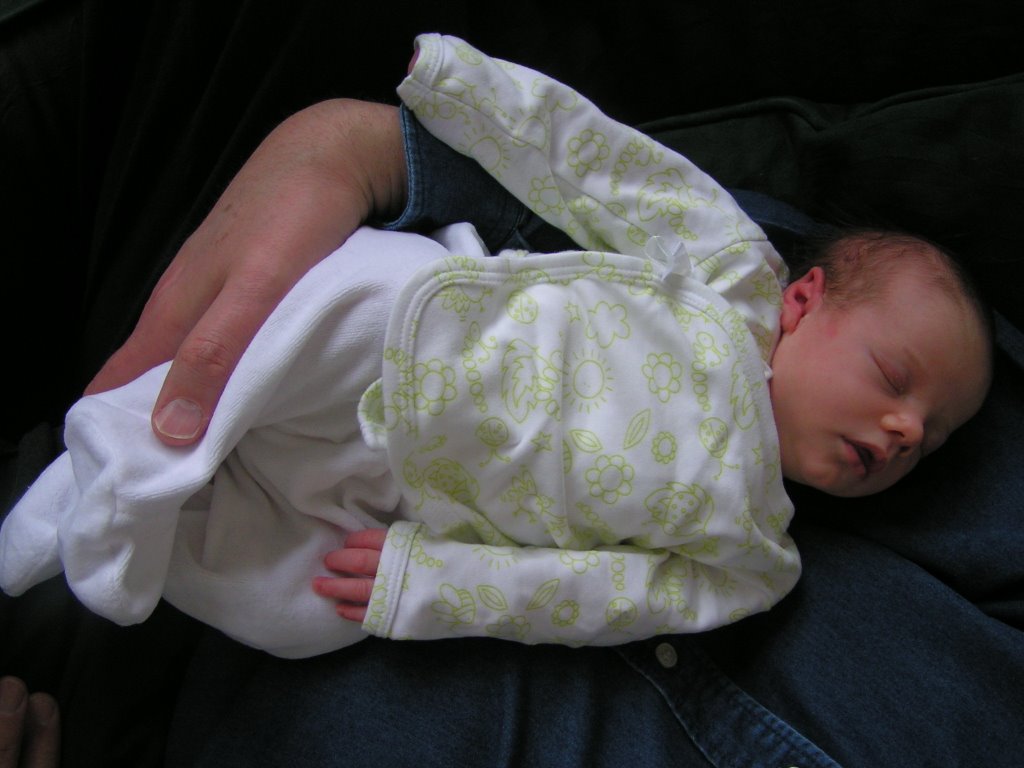
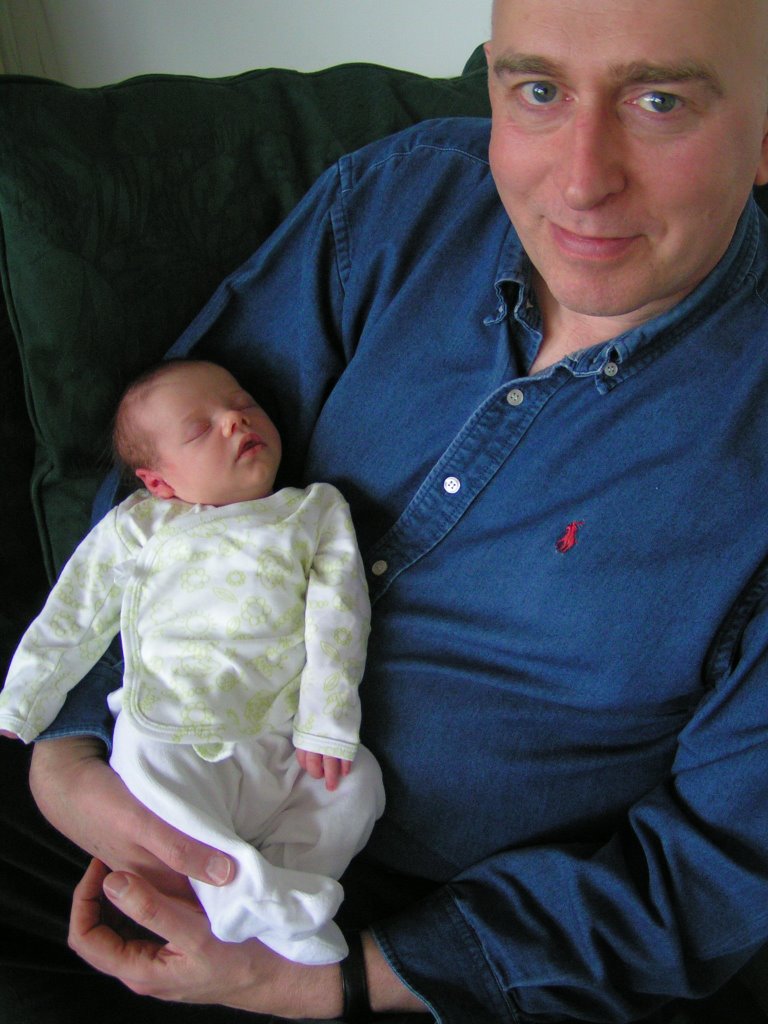
The highlight of the day was to hold a beautiful young lady of Geordie & Dutch heritage, a wonderful mixture.......


....but everything has a price and in this case it was to participate in the quaint Dutch tradition of 'beschuit met muisjes'.

Beschuits are rusks and Muisjes are, literally, mice but in this case coloured aniseed 'sprinkles'. This name was chosen, because the sprinkles look like mice droppings, mmm, nice.

As early as the 17th Century dutch parents of a newly born baby would give these rusks, with a layer of butter and muisjes, to visitors, with pink and white muisjes for a girl child and blue and white for a boy.

I am indebted to the happy parents for not having had mixed twins.

De Ruijter is the only producer of muisjes.

.

Tuesday, March 07, 2006

Feliz aniversário!


another Birthday greeting, this time for the Matriarch of the family who is spending her special day somewhere near the fair city of Lisbon.

Thursday, February 23, 2006

Flight ED352. 57 Squadron.

57 Sqdn: Corpus non Animum Muto (I Change my Body, Not my Spirit)

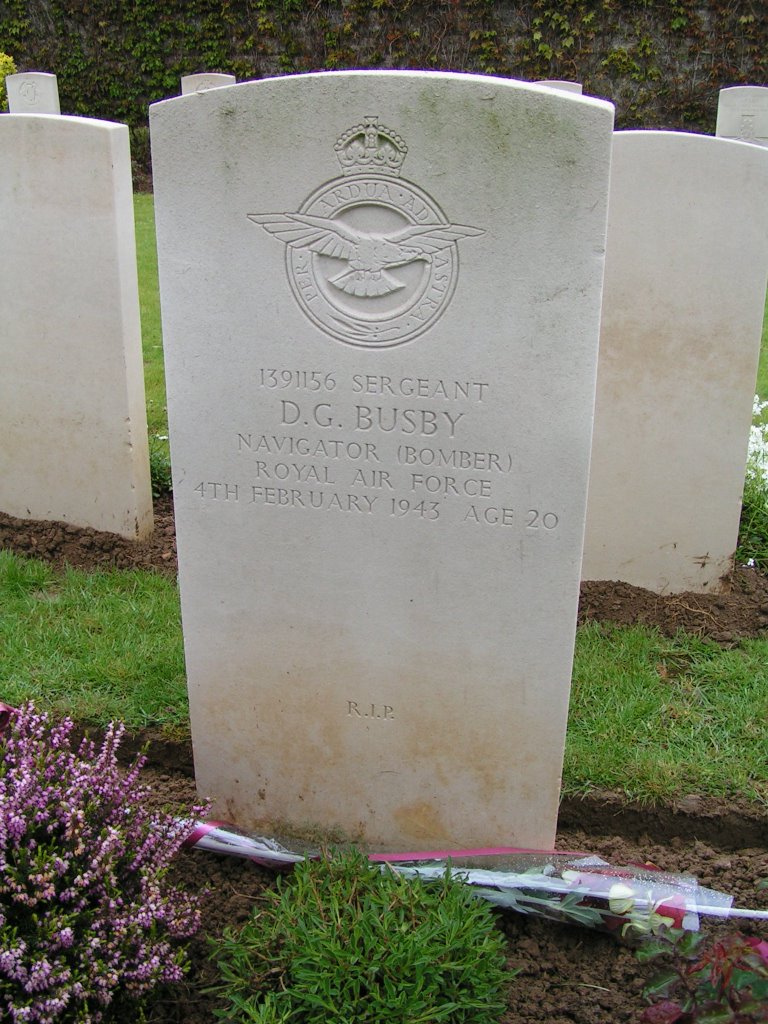
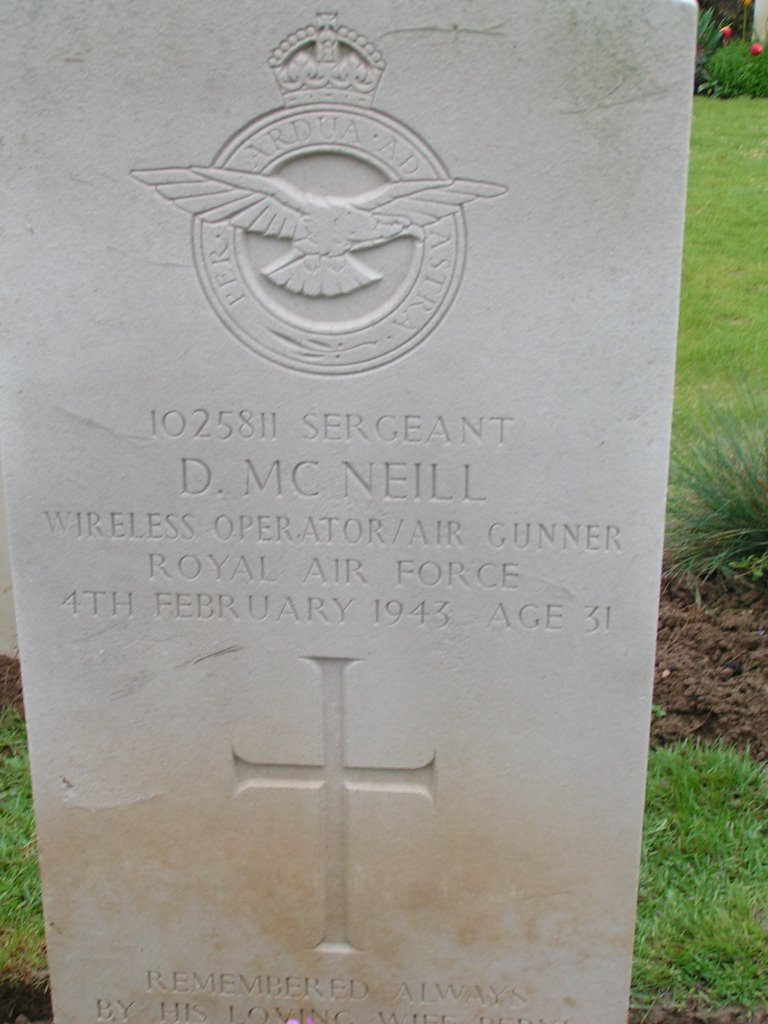
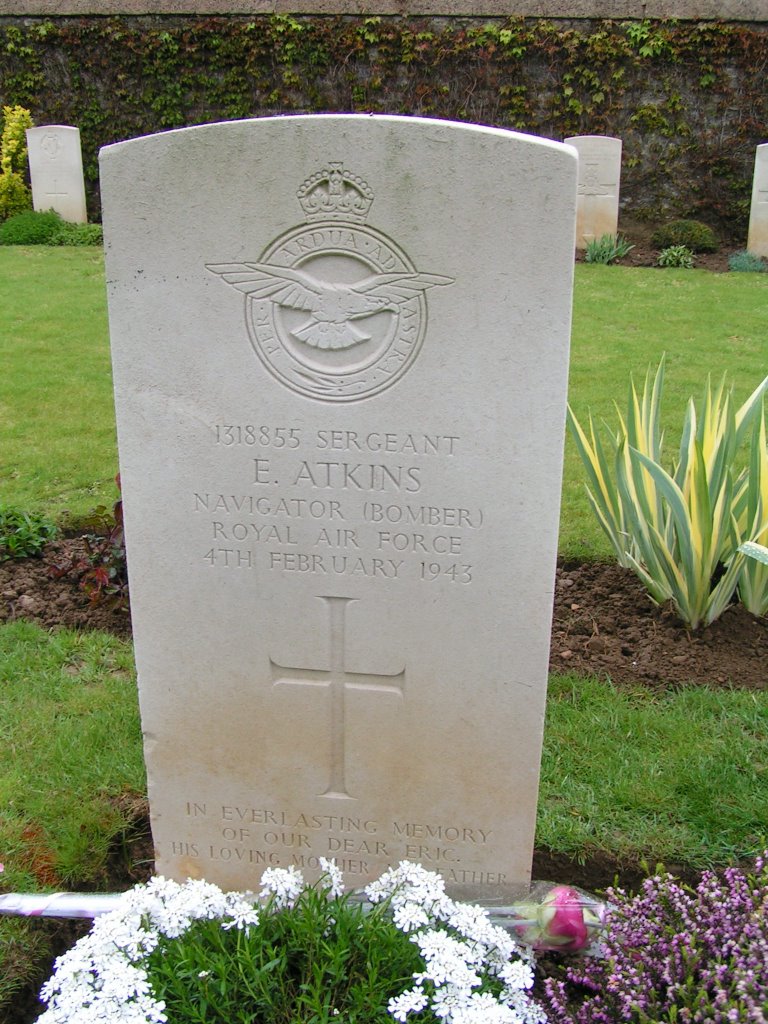
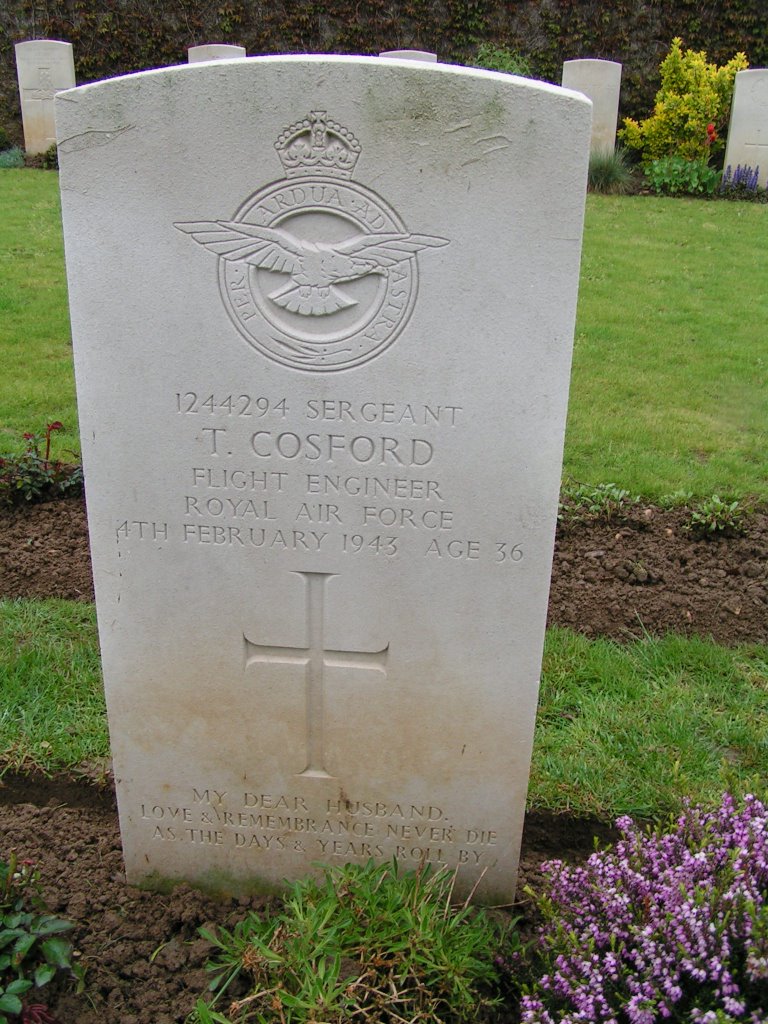
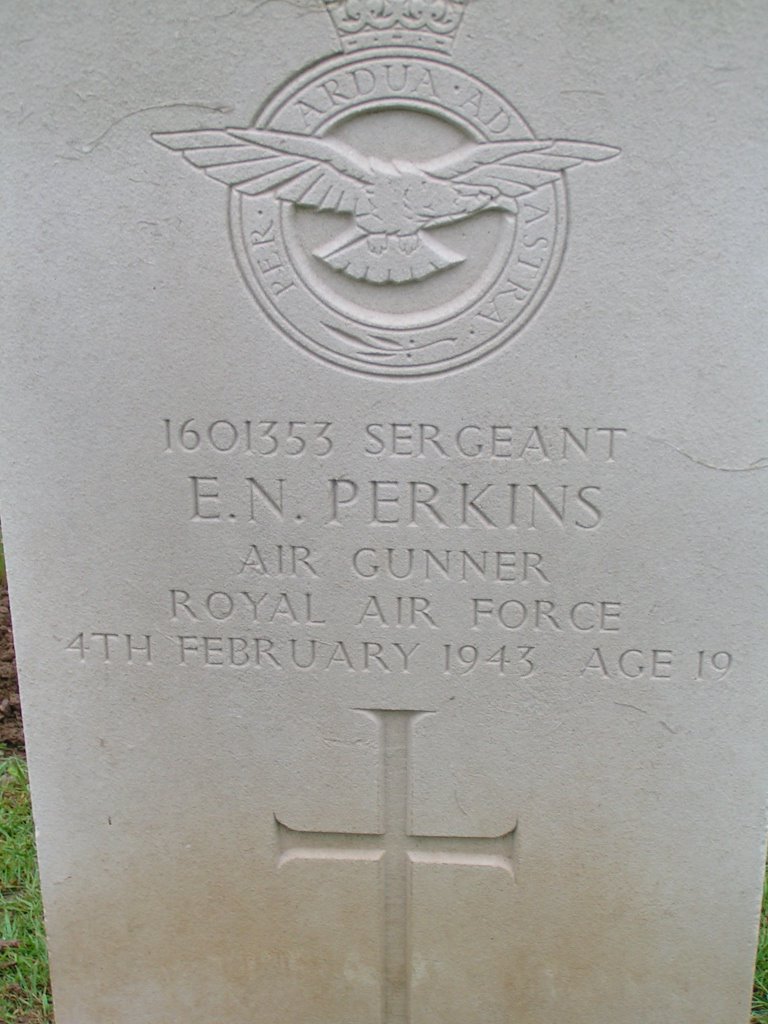
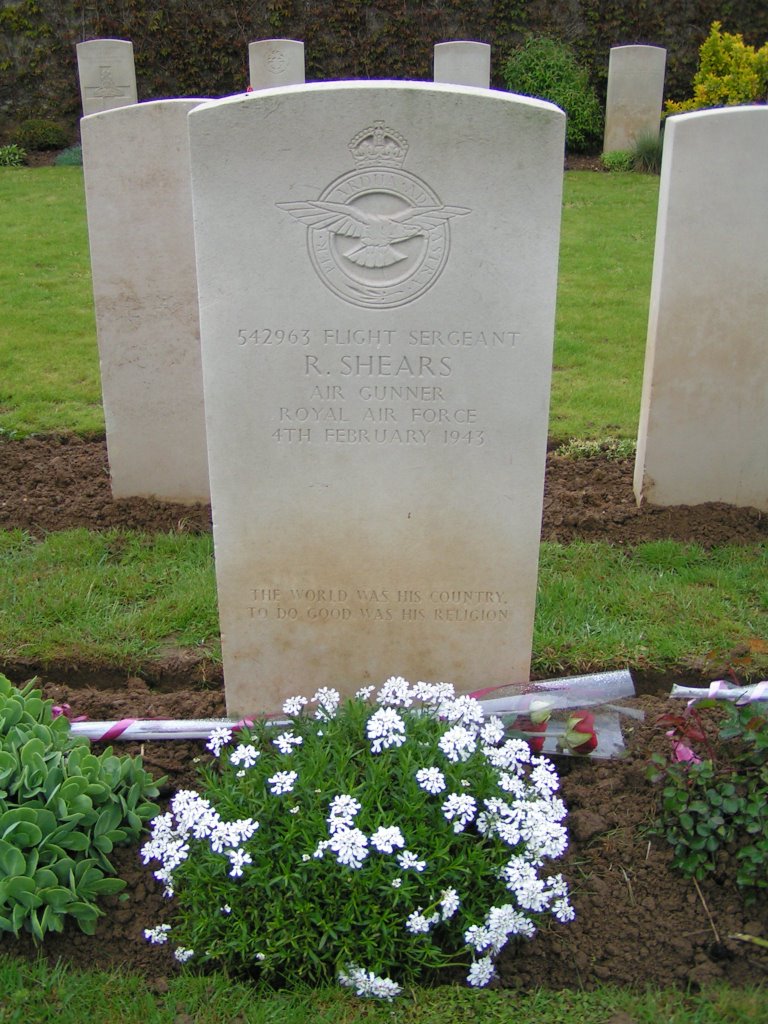
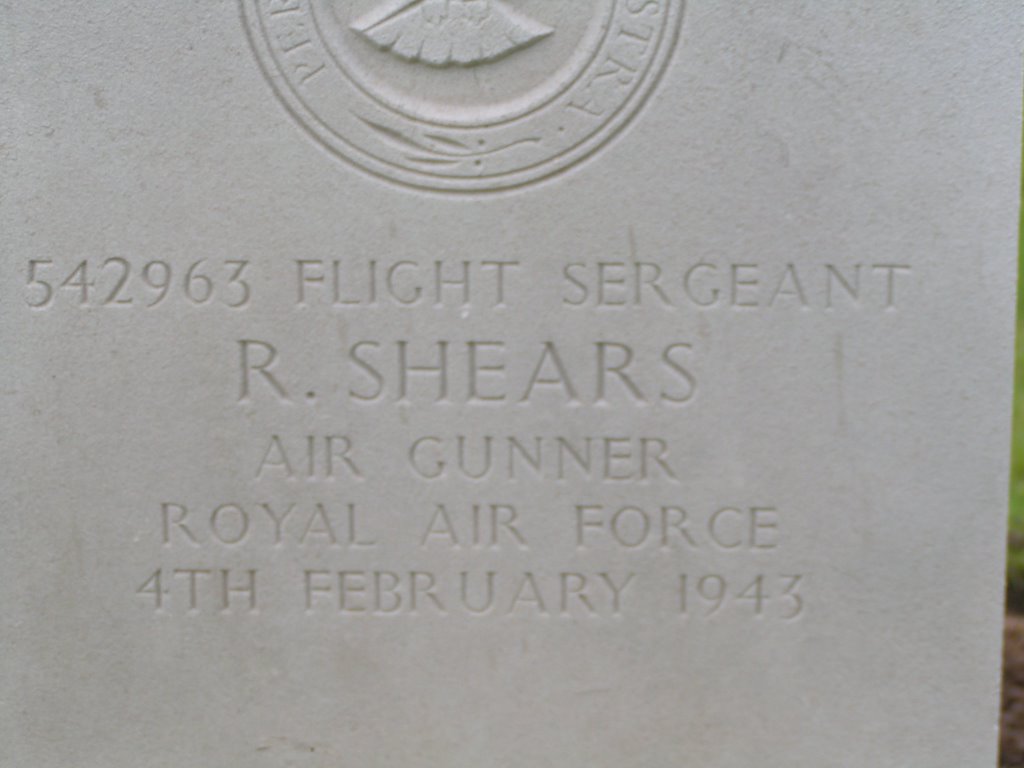
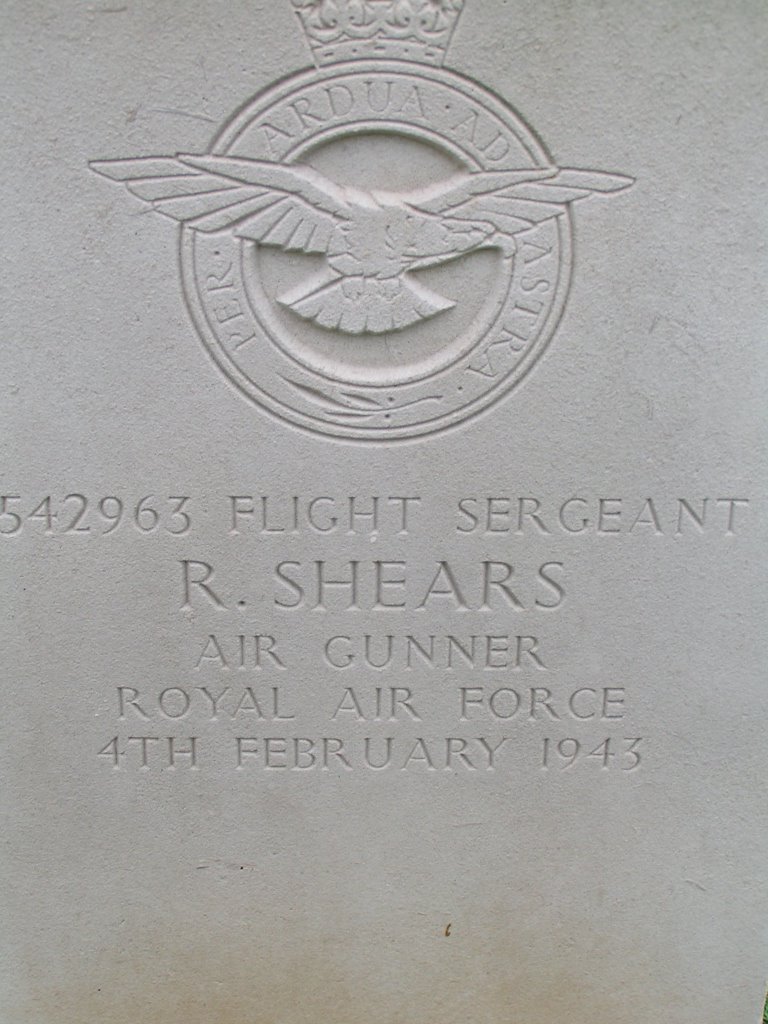
63 years ago on the night of 4/5 February 1943 a brave young aircrew from 57 Squadron took-off from RAF Scampton in their Lancaster which rose slowly into the clear and freezing winter skies above the flat Lincolnshire landscape. The plane's flight path took it across the Normandy coast at Cabourg, on to Aix- les-Bains in the French Savoie and then high over the Alps into Italy to bomb strategic targets, including the Fiat works, in Turin, Italy.


Sadly, three aircraft, all Lancasters, including ED 352 were not to return home from the raid. The RAF night raid report records that two returning crews reported that they had seen an aircraft crash into the Alps near Mount Cenis. This was almost certainly ED 352 as several years ago one Gordon Busby, by then an octogenarian, told me that on a visit to Bourg St Maurice in the Haute Savoie he had met an elderly man, once a mountaineer, who had helped bring the bodies of the crew, including that of his brother Denis, down from the mountains in June 1943, from an area way above the snow line and only accessible in the summer months.

The plane was piloted by Alister Ritch a 22 year old Canadian from Toronto; his navigator/bombers were Denis Busby, 20, from Hastings Sussex, and Eric Atkins, age unknown, of Southampton. The flight engineer was Thomas Cosford, 36, from Wembley, Middlesex and the air gunners were Douglas McNeil, 23, from Stockport, Eric Perkins ,19, from Surrey and rear gunner Ronald Shears, my mother’s cousin, 24, from Jesmond, Newcastle upon Tyne.

All bomber crew were volunteers.

The crew are remembered in the Book of Remembrance in Lincoln cathedral and are laid to rest in a small Commonwealth War Graves Cemetery in the village of St. Germain-au-Mont-d’Or above the Rhone valley to the north of Lyons.


.

New Arrival

Eve Elizabeth

born Thursday 23 February 2006

Welcome

Go well little one.

Tuesday, February 14, 2006

Valentine's Day Chinese Style

Today is the birthday of the son of the family and he will spend it in far away Guandong province.
The Chinese equivalent of Valentine's Day falls on the seventh day of the seventh lunar month and on that day children are told they are unlikely to see any magpies as they will all have gone to form a bridge, in the heavens, on which lovers Niu Lang and Zhi Nu will meet.

This legend was first recorded in the Jin Dynasty (256-420 AD) and tells of a doomed romance between Zhi Nu, the youngest of seven daughters of the Queen of Heaven, and Niu Lang , a poor orphaned cowherd who had been driven out of his home by his elder brother and his cruel wife.

Niu Lang's only friend and companion was an old, but magical, cow who contrived for Niu Lung and Zhi Nu to meet at a river where she and her sisters were bathing. They subsequently lived happily together for several earth years and had two children. This was until the Queen of Heaven realised Zhi Nu was missing , earth years being only days in the heavens, and forced her to return.

Niu Lung was heartbroken but remembered that his cow, who had died of old age, had told him to keep the cowhide for use in emergencies. Donning said cowhide, Niu Lang followed Zhi Nu to the heavens but the Queen used a hairpin to draw a line between the two lovers and that line became the Silver River in Heaven known to us as the Milky Way.

Zhi Nu missed her husband so much that eventually her mother relented, but only slightly, and decided to allow the couple to meet once every year on the Silver River with the help of all those magpies.

A poem about the legend was written by Qin Guan from the Song Dynasty (960 -1279).

Fairy Of The Magpie Bridge


Among the beautiful clouds,

Over the heavenly river,
Crosses the weaving maiden.
A night of rendezvous,

Across the autumn sky.
Surpasses joy on earth.
Moments of tender love and dream,
So sad to leave the magpie bridge.


Friday, January 27, 2006

"Weel may the keel row"


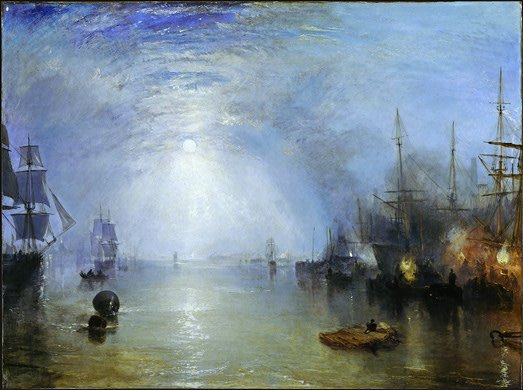
'Keelmen Heaving in Coals by Moonlight', by William Turner 1835, depicts keelmen on the River Tyne transferring coal from barges, or keels ( a word believed to be derived from a type of Anglo-saxon boat known as ceols ) to sea going vessels.

The Tyne keelmen were first recorded in 1516 and had a proud and militant history; they had their own community in the Sandgate district just outside the old city walls of Newcastle and their jobs were handed down from father to son.

In modern times the Tyne has been navigable for about 10 miles up to Newcastle but in earlier years, big ships couldn't get up the river as it was too shallow, so the Keelman's job was to ferry coal from mines up the river to the harbour mouth at North Shields, from where collier sailing ships would take their cargo down the East coast to London.

The Tyne keel was a type of barge typically holding about twenty tons of coal and was rowed in all weathers, day and night. The keelmen men would row down the river on the ebb tide, assisted by a sail if the wind was favourable, and after off-loading the coal would row back to Newcastle on the flood tide.

Coal was the lifeblood of Tyneside for centuries and Keelmen were first recorded as a fraternity in 1539. In 1697 they organised a charitable fund and established the Keelmen's Hospital in 1701 and the building survives to this day:

 
Keelmens Hospital. Newcastle upon Tyne

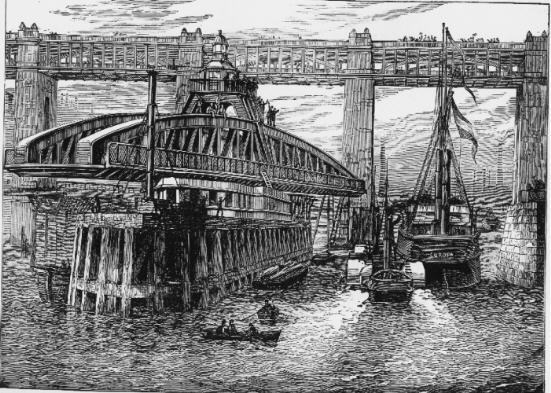
When the Swing Bridge replaced the old, low arched, Tyne bridge in 1876 it meant that larger vessels could then sail up stream to load coal from mines up the river and this was one of the final blows to the keelmen's trade

.
The Swing Bridge from the London Illustrated News.1876.

As steam power took over, keelmen began to carry less coal and more general merchandise. Keelmen helped found the Tyne Watermen's Association in 1870 and there were still 480 union members working on the river by 1892 but by 1910 the union was reduced to 310 members but remained independent until amalgamation with the then Northern District of the National Union of General and Municipal Workers in 1936. Ironically, coal is nowadays  imported to the Tyne

All that remains of the vibrant keelmen community of Sandgate is a collection of folk songs of which the `The Keel Row' is the most famous:

"As aa came through Sandgate,
Through Sandgate, through Sandgate,
As aa came through Sandgate
Aa heard a lassie sing:
Weel may the keel row,
The keel row, the keel row
Weel may the keel row
That ma laddie's in."

The 1881 census lists Great Grandfather George as a Keelman at a time when technological and other changes had pretty much destroyed the traditional role of the keelmen. The Matriarch of the family says George was to become an Inspector in the City Lighting department in the days of gas lighting. Town gas in those days was produced from coal so in a way he had transferred from one end of the supply chain to the other, and it was the Newcastle upon Tyne City Lighting Department that brought the Gordon and Bell branches of the family together, so William Armstrong, who designed the Swing Bridge, has a lot to answer for.

Sunday, January 22, 2006

The Beatles and Newcastle United

.
Younger daughter, like her siblings, has a very catholic taste in music, ranging from hip-hop to jazz through rock to Sinatra so it should have come as no surprise when she recently began raving about some old Beatles tunes from their "No.1s" CD. She however was very surprised indeed to learn that a family friend she had visited in Sweden several years ago was a close relative of one Albert Stubbins.
.
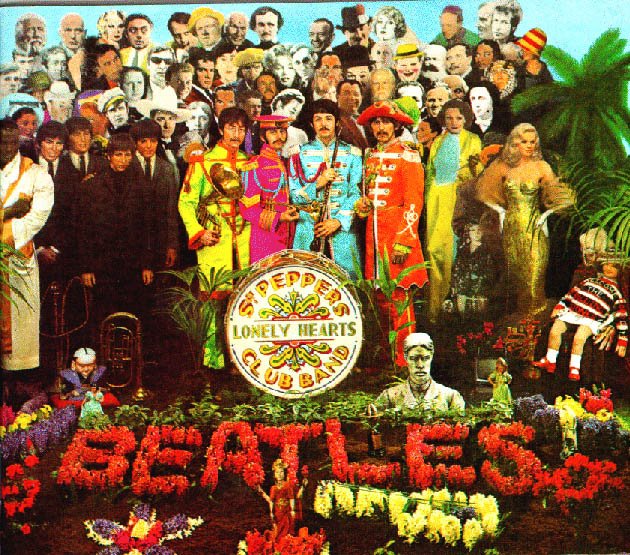
Those of you who are familiar with the cover of Sergeant Peppers Lonely Hearts Club Band may know that Albert Stubbins appears on the cover wearing a red shirt and standing next to Marlene Dietrich's shoulder
.

.
The red shirt is that of Liverpool FC a club for which Albert scored 83 goals in 180 appearances after joining the club in 1946. His goals included 24 goals in 36 games when Liverpool won the First Division title in the 1946-47 season. Despite his success at Liverpool many believe that Albert's peak years coincided with World War Two when the regular leagues were cancelled. During the 1945-46 season before regular League football was restarted, Albert scored 39 goals in the Northern League for Newcastle when, by comparison, the second-highest Newcastle scorer was Jackie Milburn with just 14 goals, yet it was Milburn who went on to become a legend on Tyneside scoring 200 goals for the club, a record only recently equalled by Alan Shearer.
.
.
programme for Aston Villa v NUFC 1945/46 Albert Stubbins at Centre Forward. No.9
.
Freddy Shepherd, the current chairman of Newcastle United, once suggested that Alan Shearer was the greatest player in the 110-year history of the Tyneside club. When Sir Bobby Robson, former Newcastle and England manager, was asked whether he agreed he replied: "Well, there was Albert Stubbins, you know." (Stubbins scored 245 goals in 199 games for Newcastle)
.

.

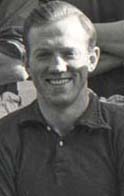
Albert Stubbins. 13 July 1920 - 28 December 2002

.

Saturday, January 21, 2006

Wherefore art thou Faustino?

How the long-suffering Toon faithful must have wished for someone with the maverick genius of Faustino Asprilla to rescue them from a dismal home defeat by Blackburn this afternoon.

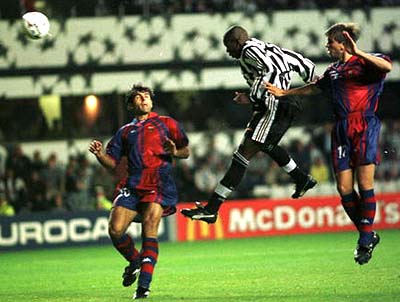
Asprilla v Barcelona

Some may remember a snowy day back in 1996 when Asprilla arrived at St James Park wearing a fur coat after his transfer from Parma in Italy. His debut, at the Riverside, saw him play for only
twenty minutes but he ran the Middlesbrough defence ragged and helped turn a one goal deficit into a 2-1 victory. He wasn't everyone's cup of tea and his rubbery legs were known to trip over the ball on more than one occasion, but in full flow he was one of the most skillful players of modern times to wear the black and white, as witnessed by the hat-trick he scored against a mighty Barcelona side containing Figo and Rivaldo . Sadly these were his last goals for United as after 48 league appearances and 11 European games, in which he scored 9 goals, manager Kenny Dalglish sold him back to Parma for £6,000,000 in January 1998.

Asprilla v Barcelona

And wherefore Tino?

Now 37, he has recently announced his candidacy for election as Deputy of the Valle del Cauca department in Cali, the third largest city in his native Colombia which he represented 57 times at international level. http://espanol.sports.yahoo.com/060119/1/16iml.html

Thursday, January 19, 2006

Swansea, the Luftwaffe and South Shields

A business trip to Wales' second city this week reminded me that it is by far from being a jewel in the crown of Welsh architectural heritage. The city centre, apart from a Georgian Church and the ruins of a 13th century castle, consists entirely of drab and dreary post-war architecture and is forlorn in contrast to the powerful, natural beauty of Rhossilli Bay and Worm's Head, less than one hours drive away on the Gower peninsular.

And for that, the good folk of Swansea have the "Three Nights' Blitz" of February 1941 and post-war reconstruction to blame, because intensive bombing saw Swansea town centre almost completely obliterated by Luftwaffe raids seeking out the strategically important docks nearby, and, as a Swansea born colleague told me, " what the Luftwaffe missed the Council finished off"

And in the old dock area, fortuitously missed that night by errant German navigators and bomb aimers, there are now smart apartments and a marina full of gleaming yachts and motor cruisers, and nearby, where old colliers and cargo ships abrim with coal, iron and copper would once have berthed, is the wonderful National Waterfront Museum: "Wales story of industry and Innovation" :

tp://www.museumwales.ac.uk/nwms/dynamic/home_eng.php

and there, amongst many interactive and computerised displays, is a ' virtual' tour of some properties surveyed in the 1851 census which recorded amongst the good folk of Swansea a gentleman from Northumberland and a lady from South Shields, both far from home but still in a land of coal.

Monday, January 16, 2006

Salmon, Trafalgar and Great Grandfather George

Now what links the three you may well ask, and the answer would be the coaly waters of the river Tyne.

According to the Matriarch of the family the waters of the Tyne are now so clean that it is the finest river for rod caught salmon in the UK. So much so that the Western Mail recently reported that the Tyne had the highest catch of any British river, 4,122 in 2004. Now this should come as no surprise to those of us who, at a friend's 50th birthday a few years ago, spied a seal near the new Millennium pedestrian bridge which links Newcastle to Gateshead, no doubt drawn by the mouthwatering prospect of some fresh Tyne salmon.

And Trafalgar and Great Grandfather George?

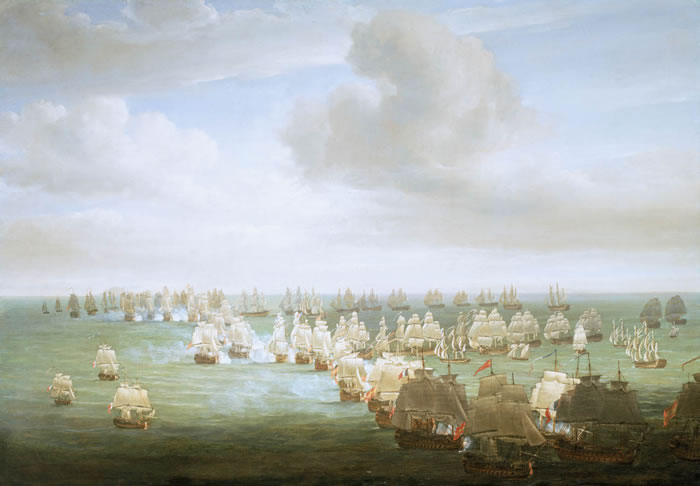
Well, one Cuthbert Collingwood was born on the banks of the River Tyne in Newcastle in 1748 and went to sea at the age of twelve; by the time of the battle of Trafalgar in 1805 he was not only vice-admiral of the British fleet but it was his ship, the Royal Sovereign, which was the first to engage the French & Spanish fleet and it was Collingwood who took command of the fleet and led it to victory whilst Nelson lay mortally wounded .


The Battle of Trafalgar, 21 October 1805: Beginning of the Action' Artist Nicholas Pocock circa 1808

As for great grandfather George, he was a keelman on the Tyne, and from an old Tyneside poem of 1820:

"Our keelmen brave, with laden keels,
Go sailing down in line,
And with them load the fleet at Shields,
that sails from coaly Tyne.

When Bonaparte the world did sway,
Dutch, Spanish did combine;
By sea and land proud bent their way,
The sons of coaly Tyne.

The sons of Tyne, in seas of blood;
Trafalgar's fight did join,
When led by dauntless Collingwood,

The hero of the Tyne.

Sunday, January 15, 2006

Art, a large wooden shed and a birthday breakfast

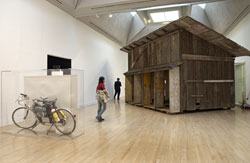
Picture if you will, a very large wooden shed, or, for anyone short on imagination, see the one below:

Shedboatshed (Mobile Architecture No 2) 2005. Simon Starling.
I saw this piece of 'installation' art, whose 'artist' won this year's Turner prize, at Tate Britain yesterday. Now call me an old fashioned Philistine if you like, but when this shed, which was dismantled, converted into a boat, rowed down the Rhine and re-built, is described as "a kind of buttress against the pressures of modernity, mass production and global capitalism" I am reminded, more than somewhat, of Hans Christian Andersen's Emperor's New Clothes .
Much more rewarding was the exhibition, elsewhere in the gallery, which explores the works of, and relationships between, Degas, Toulouse-Lautrec and Sickert and other contemporaries. Their work is not only interesting, visually pleasing and stimulating but also demonstrates great artistic skill and technique, rather than just an avant garde imagination. Judge for yourself at the wonderful Tate website:

http://www.tate.org.uk/Britain/exhibitions/degas/roomguide.htm

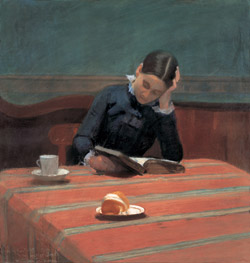
A painting that stood out for me was CMS Reading by Gaslight by William Stott of Oldham (1857-1900) :

It is a portrait of Stott's wife and, being hitherto unfamiliar with Stott's work, I was interested to learn that he exhibited regularly at the Paris Salon and that Sickert described him as ‘one of the two greatest living painters of the world.’

As for the birthday breakfast, a special mention, and thanks, to younger daughter who prepared a fine one for me this morning.

Tuesday, January 10, 2006

Geordies and Mackems

Growing up, as I did, in the Newcastle upon Tyne of the 50s and 60s, you always knew you were a 'Geordie' and that people from nearby Sunderland on the river Wear were, well sort of Geordies but not quite. There wasn't a special name for Wear-siders. Latterly the term 'Mackem' has described people from Sunderland and supporters of their football club but only really since the 90s, so a fairly modern development.

Last night's "Balderdash and Piffle" on the BBC sought to track down the earliest recorded written evidence of the word Mackem, and courtesy of the BBC and the Oxford English Dictionary: http://www.oed.com/bbcwords/ I reproduce below some extracts from the etymology & definitions of Geordie & Mackem. As for the innate superiority it is claimed Newcastle folk have over their brethren in Sunderland I shall leave it to readers to make up their own mind:

from the OED:

1. (yellow) Geordie: a guinea. (Cf. GEORGE 4b.)
1786

2. a. A coal-pitman. b. A collier-boat. c. (See quot. 1881.)
1876 C. M. DAVIES Unorth. Lond. 353 A "Geordie", or pitman. 1881 RAYMOND Mining Gloss., Geordie, the miners' term for [George] Stephenson's safety-lamp. 1884 W. C. RUSSELL Jack's Courtship xliv, You thought..of the Channel aswarm with just such vessels as she Geordies deep with coal.

3. a. A native or inhabitant of Tyneside.

1866 C. NORDHOFF Young Man-of-War's Man iv. 69 The sailors belonging to the ports on the north-eastern coast of England are called Jordies.
1892 R. O. HESLOP Northumberland Words I. 196 The men who went from the lower Tyneside to work at the pits in South Tynedale were always called Geordies by the people there.

Mackem, n.

DRAFT REVISION Jan. 2006
Prob. with allusion to phrase mack' em and tack 'em and variations thereof, said to refer to the shipbuilding industry of the region, the suggestion being that in Sunderland they make ships (mack 'em) so that others can take them (tack 'em), or, specifically, that the Geordies of Tyneside would then take them to fit them out.
A native or inhabitant of Sunderland or Wearside; a supporter of Sunderland Association Football Club. .
The good citizens of Newcastle are aware and proud of their h-fulness: they believe that this is another instance of their inherent superiority to the 'Mackems' (citizens of Sunderland).

The earliest written record found : 1988 Sunderland Echo 17 Oct. 6/4 Five children and seven grandchildren, all Mack-ems

Sunday, January 01, 2006

Welcome 2006. Happy New Year


Norman Rockwell's Do Unto Others (1961) Image courtesy of Carol L. Gerten

and Happy Birthday to D

Saturday, December 31, 2005

A Look back at 2005

Too much to mention here but the year began with the departure of the young man of the family to the People's Republic of China, a significant and unfinished chapter in family history, and it ended with a pair of his Timberlands in transit to him in Guandong province, courtesy of DHL. Go well son.


In April a visit with my mother to a small Commonwealth war graveyard near Lyons to see the final resting place of her cousin Ronald and the other members of his Lancaster crew; some of the many who made the ultimate sacrifice in the war against fascism.


http://www.cwgc.org/cwgcinternet/search.aspx

On a lighter note, In August there was a great trip to Northumberland with dear friends, which, by fortuitous happenstance, took in a match at St James Park :


Go there daughter, forget that Chelsea aberration.

followed by a delightful exhibition in Edinburgh:

A trip to New York City in October was a memorable one.


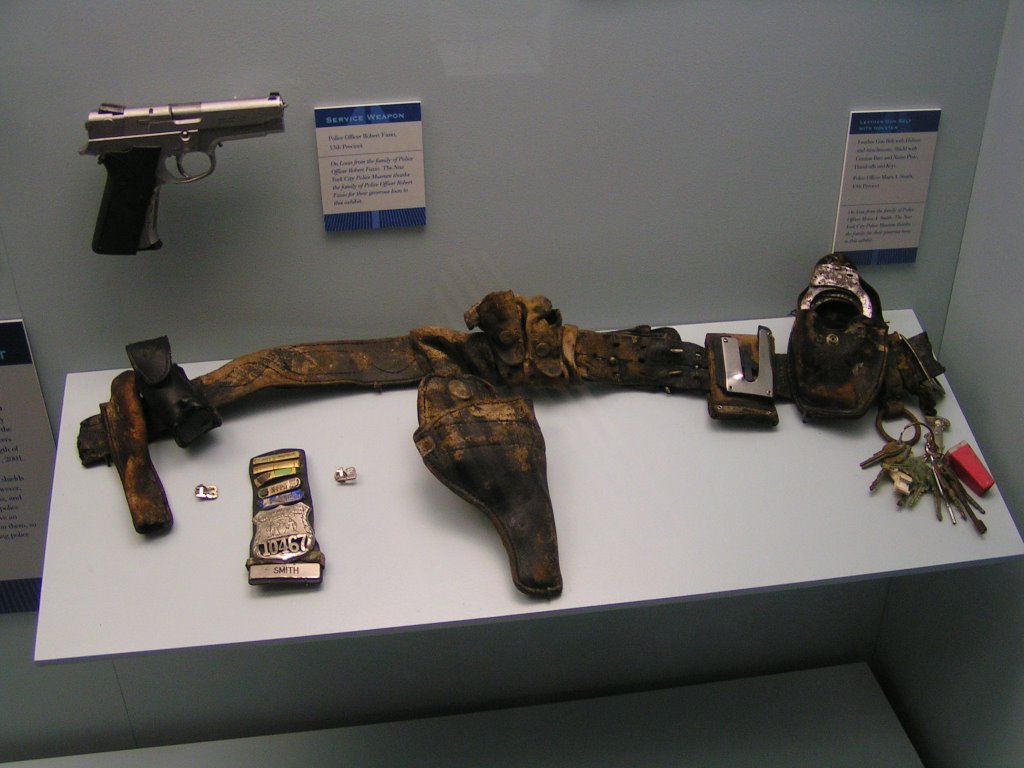
The NYPD Museum at 100 Old Slip near the waterfront in Downtown Manhattan was a little gem; with some moving and haunting exhibits from 9/11 such as this:

and sadly:

Grandpa Agor RIP.

Thursday, December 29, 2005

Blizzard ruins Charlton's trip to North-East

picture from Newcastle Evening Chronicle

Snow affected the eastern fringes of the UK yesterday including Tyneside where hardy Charlton fans, who had travelled 300 miles to see their team play Newcastle, were unhappy when their match against the Geordies was abandoned because of the weather: The match was not the only thing abandoned in Newcastle; my friends' Italian sports car was snowed in forcing them to return to Edinburgh on the train.

http://football.guardian.co.uk/News_Story/0,1563,1674754,00.html